
Language

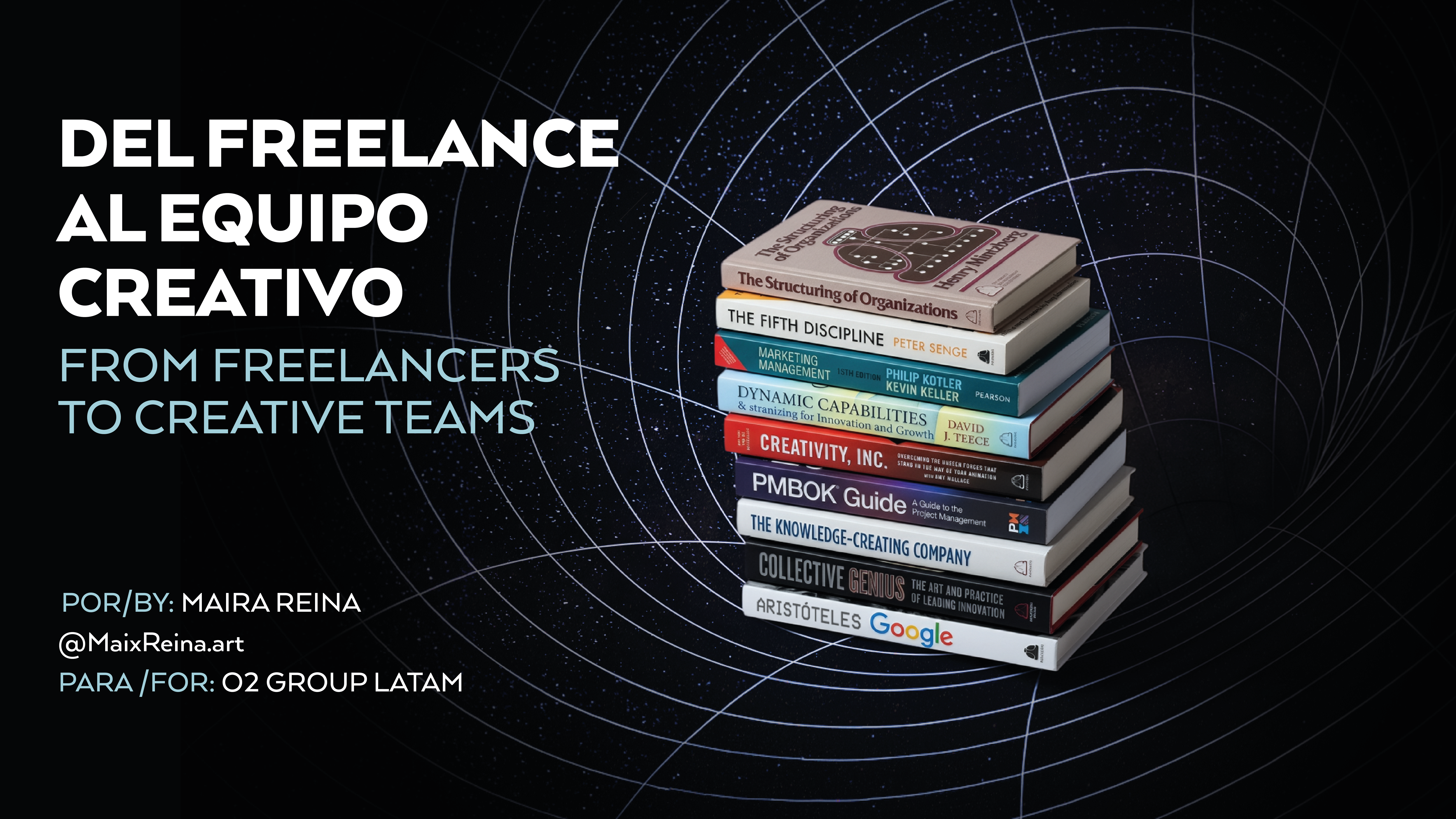
Many companies believe their marketing challenge is simply finding better designers, better social media managers, or more skilled specialists. However, research in management, innovation, marketing, and organizational leadership suggests that the real challenge is something else entirely: building a system that connects strategy, creativity, and execution.
Below are nine influential academic and business references that help explain why medium-sized and large organizations achieve better results when they evolve from hiring individual freelancers to building interdisciplinary creative teams.
1. The Structuring of Organizations (1979) — Henry Mintzberg
Henry Mintzberg explains that as organizations grow, they require higher levels of coordination across their different functions.
A small company can rely on individuals. A medium-sized company needs systems. A large company needs processes.
Growth doesn't just increase the workload—it also increases the need for coordination.
2. The Fifth Discipline — Peter Senge
Peter Senge argues that organizations learn when knowledge no longer depends on a single individual.
When knowledge remains concentrated in one person, organizations face information loss, dependency, rework, and reduced innovation. Teams, on the other hand, foster collective learning and build capabilities that remain within the organization.
3. Marketing Management — Philip Kotler
One of the most common misconceptions is that marketing is simply about design or social media.
Philip Kotler defines marketing as the integration of strategy, market research, positioning, communication, product development, customer experience, and sales.
It is virtually impossible for one person to master all of these disciplines at the same level.
4. Dynamic Capabilities and Strategic Management — David J. Teece
David J. Teece demonstrates that successful companies don't outperform competitors simply because they employ talented people.
Their true competitive advantage comes from developing repeatable organizational capabilities: processes, coordination, continuous learning, and teams that can adapt to new challenges.
Strong organizations build systems—they don't depend on isolated individuals.
5. Creativity, Inc. — Ed Catmull
Ed Catmull, co-founder of Pixar, explains that creativity thrives through collaboration.
Pixar never built its success around the idea of the "creative genius." Instead, it created a system where hundreds of people could challenge, refine, and continuously improve ideas.
His conclusion is powerful: the best ideas come from the best teams, not from the most talented individuals.
6. Pulse of the Profession — Project Management Institute (PMI)
Research from the Project Management Institute shows that successful projects consistently share the same characteristics: clearly defined roles, accountable leaders, structured timelines, effective communication, and quality control processes.
When organizations rely exclusively on freelancers, they often encounter inconsistent methodologies, limited documentation, poor continuity, and weak knowledge transfer.
Not because freelancers are less capable, but because this model was never designed to coordinate complex organizations.
7. The Knowledge-Creating Company — Ikujiro Nonaka and Hirotaka Takeuchi
Nonaka and Takeuchi argue that knowledge is one of an organization's most valuable assets.
When everything depends on a single designer, strategist, or external contractor, knowledge leaves when that person leaves.
Teams, by contrast, document processes, share experience, and transform individual expertise into organizational knowledge.
8. Collective Genius: The Art and Practice of Leading Innovation — Linda A. Hill, Greg Brandeau, Emily Truelove, and Kent Lineback
The authors conclude that innovation is not driven by individual talent but by an organization's ability to create environments where diverse perspectives collaborate, challenge one another, and develop better solutions.
Innovative companies don't search for creative heroes—they design systems that make innovation repeatable.
9. Project Aristotle — Google
Google studied hundreds of teams to understand what distinguished high-performing groups from the rest.
The findings were surprising: individual talent was not the determining factor.
The highest-performing teams consistently demonstrated strong coordination, clear goals, effective communication, and psychological safety—qualities that are difficult to achieve through isolated client-contractor relationships.
Although each of these authors approaches the topic from a different perspective—management, innovation, marketing, knowledge management, or leadership—they all arrive at a similar conclusion:
As organizations grow, coordination becomes more valuable than individual talent.
That's why, at O2, we believe in interdisciplinary teams where strategy, creativity, and execution work as one. Not because freelancers are less capable, but because the complexity of medium-sized and large organizations demands shared processes, clear accountability, and a collective vision capable of sustaining long-term growth.
If your business is growing and you're facing new challenges in innovation, brand positioning, and cross-functional coordination, let's start a conversation. We can help you build a creative system that transforms your goals into measurable, sustainable results aligned with your business strategy.
We create living, breathing brands and narratives that make a lasting impact.